
Introduction
In manufacturing, much depends on the physical end product. Traditionally, you need the physical product to see how a machine behaves on-site. How does the machine respond to the designed software? What happens during a product modification? And how do individual components interact when the machine is running?
This reliance on physical prototypes or test setups often leads to delays and higher costs. Only once a machine or component is actually built does it become clear whether assumptions made during the design process are correct.
At the same time, software is developing rapidly. Virtual capabilities in design and simulation therefore offer significant advantages. At MechDes, we make intensive use of these digital tools: in a virtual environment, we can test designs, experiment, and share with clients or stakeholders through VR and AR visualizations.
We also participate in the innovation project PARADAIM under EFRO Oost 2021-2027. Led by Perron038 in Zwolle, various partners from the manufacturing sector collaborate on a current challenge: how can Artificial Intelligence (AI) be integrated into the engineering process? For example, AI can be used to simulate realistic system behavior and test designs at an early stage.
The more a design is tested, the faster design errors become visible. And the earlier a fault is discovered, the smaller the impact on planning, costs, and lead time. That is why we continuously expand our virtual activities in the design process. Two key questions guide this process:
- Is the virtual model realistic enough?
- Does the virtual model provide real added value compared to a physical model?
When the answer to both questions is ‘yes,’ we set up a virtual model and use it for testing and simulation. This can be a complete machine, but often it concerns specific components or complex processes that are difficult to predict. Predictability is essential, as clients want to know what they are investing in: what is the machine cycle time, and what is the payback period?
Digital Twin or virtual model: what’s the difference in the machine design phase?
The term Digital Twin is often mentioned in relation to virtual models. At MechDes, however, we do not use this term by default during the design phase. A Digital Twin implies a digital replica of an existing physical machine. During design, that physical machine does not yet exist, so the concept of a true Digital Twin is not yet applicable.
We therefore prefer to speak of a digital or virtual model. Nevertheless, there are important similarities: the model must behave as realistically as possible. Physical behaviors such as sliding, falling, deforming, accelerating, and collisions must be realistic in the virtual model so engineers can perform reliable simulations.
In this way, a digital model provides the same insights as a future physical machine, but at a much earlier stage. This accelerates the design process and reduces risks in complex or innovative machine concepts.
Artificial Intelligence in engineering: new possibilities for design and analysis
In addition to virtual simulations, Artificial Intelligence is having a rapidly growing impact on engineering. How AI is applied is still evolving, but experimentation is essential.
The low-hanging fruit, such as using trained AI chatbots in a closed digital environment, is already being used to support documentation and knowledge sharing. More complex, but also more promising, is training AI models based on company-specific data for company-specific functionality integrated with existing engineering software packages. Integration with existing engineering software offers potential to analyze designs faster and smarter.
Successful AI application requires in-depth knowledge of models, datasets, and software integration. With support from EFRO Oost 2021-2027, we can explore such applications together with partners in the PARADAIM project.
A key first lesson is that data organization is crucial: without structured, accessible data, reliable AI is impossible. Data forms the foundation on which models learn and make predictions.
AI-driven collision detection in SolidWorks assemblies
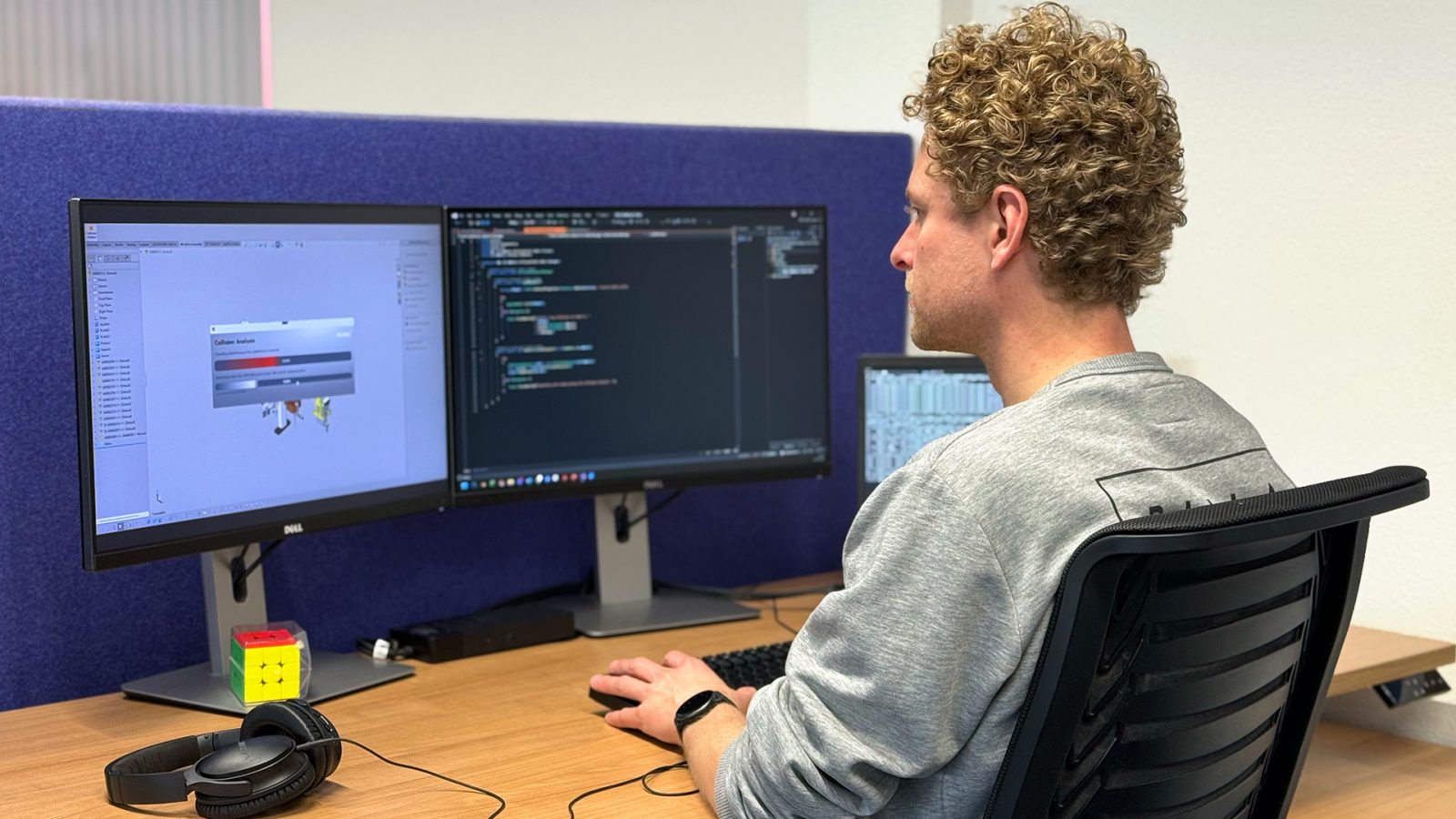
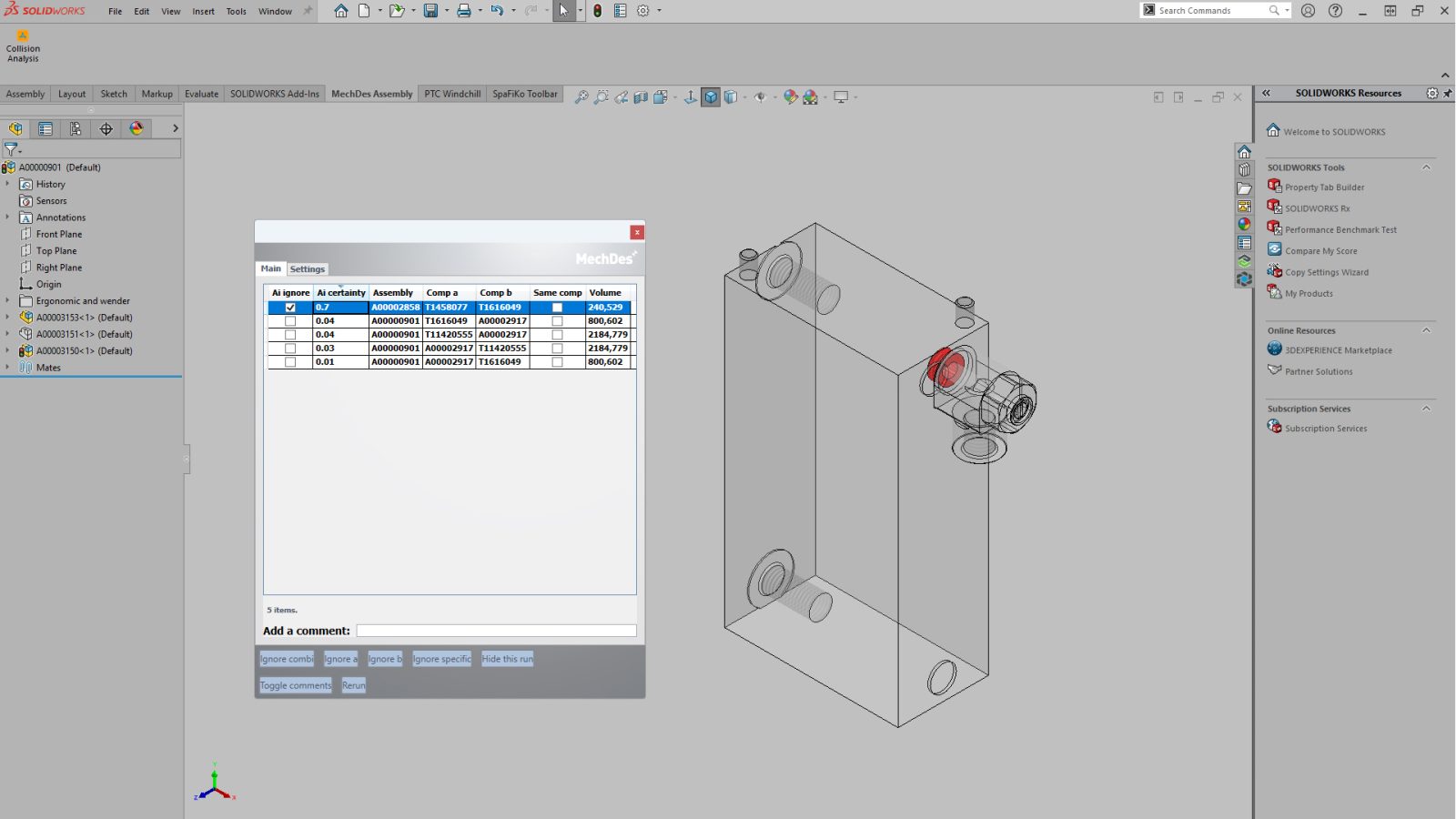
A concrete AI application at MechDes is analyzing collisions in SolidWorks designs. Machine designs consist of assemblies and components that can come into contact during movement or assembly. Collisions can be static or dynamic.
SolidWorks has a standard Interference Detection Manager that detects all overlapping components. In practice, however, this generates hundreds to thousands of alerts, of which over 95% are usually irrelevant. Examples of non-relevant collisions include:
- Collisions between bolt and nut due to thread overlap
- Sensors whose measurement ranges overlap
- Collisions in purchased parts that are not structurally problematic
Manually identifying relevant collisions is therefore time-consuming. Our AI model aims to create an intelligent filter that automatically removes irrelevant collisions. Engineers provide feedback on the results, after which the model learns which collisions are relevant. Step by step, the machine learning model develops its own logic and can make predictions.
Important design questions include:
- Which dataset is suitable for reliably training the model?
- Which type of AI model fits this problem?
- How should model parameters be optimally set?
This approach shows that AI is not just about algorithms, but also about engineering knowledge and data.
Ensuring quality in AI applications for engineering
Quality has been a core value at MechDes since its foundation. Ensuring high quality requires consistent processes, clear agreements, and experienced engineers.
Innovation can sometimes conflict with quality: new technologies introduce uncertainties. Therefore, the use of new tools and AI functionality must be carefully integrated. Development alone is not enough; implementation and training are equally important.
New technology requires clear onboarding processes and attention to change management. Only then can a well-developed tool truly add value without the risk of errors or inconsistencies.
Successfully applying new techniques is just as important as development itself: even the best tool delivers poor results if used incorrectly.
Next step: further integrating AI into engineering processes
The PARADAIM project runs until 2027. During this period, we gain experience with AI in engineering and conduct proof-of-concepts and demonstrators to test added value.
With the knowledge gained, we can increasingly integrate AI into daily engineering activities. The goal is to ensure that innovation and quality go hand in hand, enabling us to continue delivering reliable, well-thought-out, and efficient solutions for our clients.
Additionally, the project provides insight into how virtual simulations and AI reinforce each other: from digital models and collision analysis to predictive engineering. This brings us closer to a future in which designs can be realized faster, safer, and more efficiently.
About PARADAIM
In the PARADAIM innovation project, the companies AWL, MechDes Engineering, Hollander Techniek, Van den Bos CM, Verbruggen, and HGG Profiling Specialists collaborate with knowledge institutions Windesheim and the University of Twente, under the leadership of Perron038, to create a virtual product development process based on an AI-supported Digital Model of new machines, sensors, and control systems.
The PARADAIM partners use data acquisition and AI analysis for the design, development, and virtual commissioning of a Digital Model of a new production machine. Based on this optimized Digital Model, the "Physical Twin" of the new machine is then realized. In addition to quality optimization and thus higher market value of the end product, the industrial partners expect to save significant development and commissioning time—and associated costs.
PARADAIM is the third and final project following the EFRO Oost 2021-2027 projects PRISMA and BRAINS. These focused on data acquisition and AI analysis to improve production processes. PRISMA collected data via sensors and cameras, while BRAINS used the data to improve machine performance. Perron038 plays a connecting role in knowledge sharing and practical applications within the consortium.